


Starting an LLC can be one of the simpler ways to create a formal business structure in the United States. But if you are searching for how to start an LLC for free, there is an important distinction to understand: you may be able to avoid paying a formation service, but forming an LLC itself is not necessarily free.
- Can You Really Start an LLC for Free?
- How to Start an LLC Yourself
- 1. Choose the State Where You Will Form the LLC
- 2. Choose a Business Name
- 3. Choose a Registered Agent
- 4. File the Formation Document
- 5. Create an Operating Agreement
- 6. Get an EIN When Appropriate
- 7. Check Licenses, Permits, and Tax Requirements
- How Much Does It Cost to Become an LLC?
- Can You Form an LLC Without Paying a Formation Service?
- How Long Does It Take to Set Up an LLC?
- What Is a Single-Member LLC?
- What Are the Main Types of LLCs?
- How to Start an LLC for the Lowest Possible Cost
- What About Ongoing LLC Costs?
- Is Starting an LLC Yourself a Good Idea?
- The Bottom Line
The actual cost depends on the state where you form the business. Some states charge a filing fee when you create an LLC, and many also require ongoing reports, fees, or taxes after formation.
The good news is that you do not necessarily need to pay a company to create your LLC for you. In many cases, you can handle the process yourself and avoid unnecessary service fees.
Here is what the process involves, what can cost money, and how to keep your LLC startup costs as low as possible.
Can You Really Start an LLC for Free?
Usually, “free LLC” means forming the LLC yourself without paying a third-party formation company, rather than creating the business with absolutely no cost.
An LLC is created under state law, so the state where you form the business determines many of the costs and requirements. The filing fee can vary considerably from one state to another.
There may also be other expenses depending on your situation, such as:
- Registered-agent costs
- Business licenses and permits
- State tax registrations
- Annual or biennial report fees
- Franchise or other state taxes
- Optional legal or business services
So, if your state charges a mandatory LLC formation fee, you generally cannot make that fee disappear simply by filing the paperwork yourself.
What you can do is avoid paying a formation company for something you are capable of handling on your own.
How to Start an LLC Yourself
The basic process is straightforward, although the exact requirements vary by state.
1. Choose the State Where You Will Form the LLC
For most small businesses, the natural starting point is the state where the business actually operates.
Forming an LLC in another state simply because you have heard that it is “better” or cheaper can create additional complications. If you conduct business in another state, you may still have registration and compliance obligations there.
Before filing, check the requirements of your state’s business-registration authority.
2. Choose a Business Name
Your LLC will need a name that complies with your state’s naming rules.
The name generally needs to be distinguishable from other registered businesses in that state. States may also restrict certain words or require additional documentation for names associated with regulated professions.
Search your state’s business-name database before filing. This can help you identify potential conflicts before you submit your formation paperwork.
3. Choose a Registered Agent
An LLC generally needs a registered agent to receive official documents and certain legal notices on behalf of the business.
Depending on state rules, you may be able to serve as your own registered agent if you meet the requirements.
That can eliminate one recurring expense. Paying a professional registered-agent service is an option, but it is not automatically necessary for every business.
4. File the Formation Document
The document used to officially create an LLC is commonly called the Articles of Organization, although the name can differ by state.
You will typically provide information such as:
- LLC name
- Business address
- Registered-agent information
- Ownership or management information
- Other details required by the state
This is often the point where a state filing fee applies.
If your state allows online filing, you can usually complete the process yourself rather than paying a third party to submit it for you.

5. Create an Operating Agreement
An operating agreement explains how the LLC will operate.
It can address matters such as ownership, management responsibilities, decision-making, distributions, and what happens if a member leaves the business.
Some states have specific rules about operating agreements, while others do not require an LLC to file one with the state.
Even when an operating agreement is not required to be filed, having one can help establish clear rules for the business.
6. Get an EIN When Appropriate
An Employer Identification Number (EIN) is a federal tax identification number issued by the IRS.
Applying for an EIN directly through the IRS is free. Whether you need one depends on the structure and activities of your business.
For example, a single-member LLC may not always need a separate EIN for federal income-tax purposes if it is treated as a disregarded entity and has no employees or applicable excise-tax obligations. Other situations can require an EIN.
The important point is that you should not pay a third party simply to obtain an EIN when you can apply directly.
7. Check Licenses, Permits, and Tax Requirements
Creating an LLC does not automatically give you every license or permit your business may need.
Your requirements can depend on:
- What your business does
- Where it operates
- Whether you have employees
- What products or services you provide
- Local rules
- State tax requirements
A home-based consulting business, restaurant, construction company, and online retailer can have very different compliance requirements.
This is one reason the lowest-cost LLC is not necessarily the same thing as a completely cost-free business.
How Much Does It Cost to Become an LLC?
There is no single nationwide LLC price.
The biggest initial expense is often the state formation filing fee. The amount varies by state and can change over time.
You may also encounter costs after the LLC has been formed.
| Potential cost | Is it always required? |
|---|---|
| State LLC formation fee | No, it varies by state |
| Registered-agent service | No, depending on your situation and state rules |
| Operating agreement | Not always legally required to file |
| EIN | The application itself is free |
| Business licenses | Depends on the business and location |
| Annual or biennial reports | Depends on the state |
| Franchise or state taxes | Depends on the state and circumstances |
| Legal or formation-service fees | Optional in many situations |
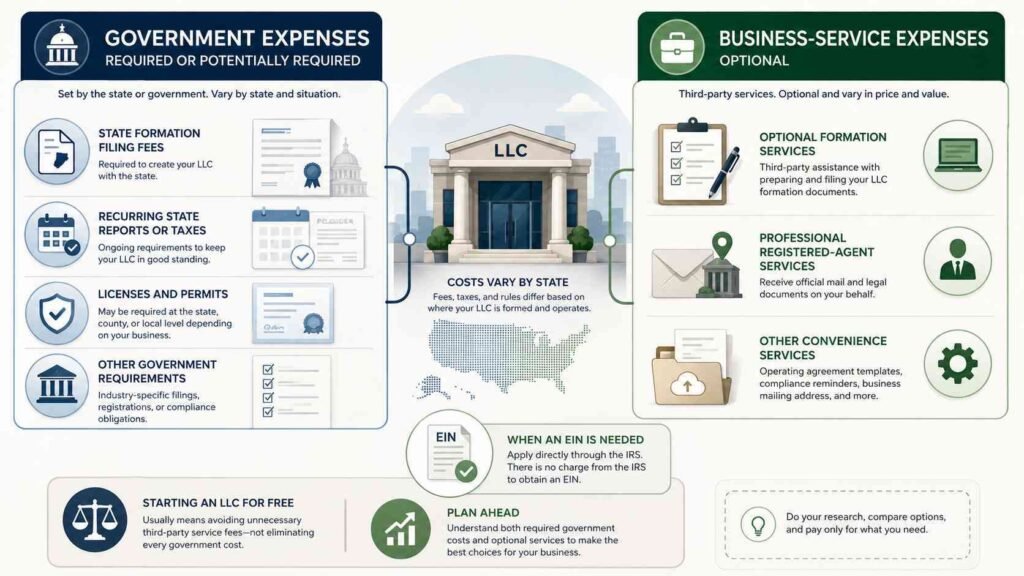
This is why asking “How much does it cost to become an LLC?” without naming the state does not produce one reliable answer.
The better question is: What does my state require to form and maintain an LLC?
Can You Form an LLC Without Paying a Formation Service?
Yes. In many cases, the business owner can file directly with the state.
Formation companies can make the process more convenient by providing guided forms, reminders, registered-agent services, or other features. But convenience and necessity are not the same thing.
If your goal is to minimize costs, compare what the state requires with what a formation service is charging you for.
You may find that some services are optional extras rather than government requirements.
The same principle applies to an EIN. If you need one, the IRS provides a free application process, so paying another company to obtain the number for you is generally unnecessary.
How Long Does It Take to Set Up an LLC?
The answer depends on the state and the filing method.
Some states offer online filing and relatively quick processing. Others may take longer, particularly when filings are submitted by mail or when additional review is required.
There is also a difference between filing the LLC paperwork and having the entire business ready to operate.
Even after the state approves your LLC, you may still need to:
- Obtain an EIN if required
- Register for state taxes
- Obtain local licenses or permits
- Open a business bank account
- Create an operating agreement
- Set up accounting records
- Obtain required insurance
- Meet industry-specific requirements
So, if you are asking how long it takes to set up an LLC, think of the process in two stages: forming the legal entity and preparing the business to operate.
What Is a Single-Member LLC?
A single-member LLC is an LLC with one owner.
It can be useful for someone who wants to operate a business alone while using an LLC structure.
For federal income-tax purposes, the IRS generally treats a domestic single-member LLC as a disregarded entity unless the LLC elects to be taxed as a corporation. That means the LLC’s business activity is generally reported on the owner’s federal tax return rather than through a separate federal income-tax return for the LLC.
That tax treatment does not mean the LLC is legally nonexistent. The LLC is still a state-created business entity.
This distinction is important: legal structure and federal tax classification are not the same thing.
A single-member LLC can therefore provide a formal business structure while still receiving relatively simple federal tax treatment in many common situations.
What Are the Main Types of LLCs?
There is not one universal list of LLC types because state laws can differ, but several structures and classifications commonly come up when people research LLCs.

Single-Member LLC
Owned by one person or entity.
This is often the simplest LLC structure for an individual business owner.
Multi-Member LLC
Owned by two or more members.
For federal income-tax purposes, a domestic multi-member LLC is generally treated as a partnership unless it elects corporate taxation.
Member-Managed LLC
The owners, or members, participate directly in managing the company.
This arrangement can work well for smaller businesses where the owners are actively involved in daily decisions.
Manager-Managed LLC
The members appoint one or more managers to handle the company’s management.
This structure can make sense when not every owner wants to participate in day-to-day operations.
LLC Taxed as a Corporation
An LLC can potentially elect to be treated as a corporation for federal tax purposes if it meets the applicable requirements.
This does not turn the LLC into a corporation under state law. Instead, it changes its federal tax classification.
That distinction is worth understanding before choosing a tax election simply because another business owner uses it.
How to Start an LLC for the Lowest Possible Cost
If your goal is to spend as little as possible, focus on eliminating optional expenses, not trying to avoid legitimate government requirements.
A practical approach is:
- File directly with your state instead of automatically hiring a formation company.
- Check whether you can serve as your own registered agent.
- Apply for an EIN directly if you need one.
- Use a basic operating agreement appropriate for your situation, rather than automatically purchasing an expensive package.
- Research licenses and permits before opening, so you do not overlook required registrations.
- Track recurring state requirements after formation.
- Separate business and personal finances once your business is operating.
The last point matters even though it does not make the LLC free. Keeping business finances organized can make it easier to maintain the separation between you and the business and keep accurate records.
What About Ongoing LLC Costs?
Forming an LLC is only the beginning.
Some states require LLCs to submit annual or biennial reports. Some also impose franchise taxes or other recurring charges.
The amount and frequency vary by state.
This is one of the biggest mistakes people make when searching for a “free LLC.” They focus on the initial formation process but overlook the cost of maintaining the business.
Before choosing where to form your LLC, look at the total cost of maintaining it, not just the initial filing fee.
Is Starting an LLC Yourself a Good Idea?
For a straightforward small business, filing an LLC yourself can be a practical way to reduce startup costs.
But “doing it yourself” does not mean ignoring legal or tax questions.
Professional advice can be worthwhile when your situation involves multiple owners, significant assets, complex tax considerations, employees, investors, regulated activities, or other unusual circumstances.
If you have not yet settled on a business structure at all, it can help to understand how an LLC differs from a corporation before filing anything.
The goal should not be to avoid every professional expense. It should be to understand which services you actually need.
The Bottom Line
You may be able to start an LLC for very little money by handling the formation yourself, but calling an LLC completely free can be misleading.
Your state may charge a formation fee, and you may have ongoing reporting fees, taxes, licenses, or other expenses. Those costs exist regardless of whether you use a formation service.
The simplest way to keep costs down is to understand your state’s requirements, file directly when practical, use free government resources where available, and avoid paying for optional services you do not need.
Before forming the LLC, look beyond the first filing fee. The better question is not just “Can I start an LLC for free?” but “What will it actually cost to form and maintain this LLC in my state?”
This article is for general informational purposes only and does not constitute legal, tax, or financial advice. Consult a qualified attorney or tax professional before making decisions about your business structure.