

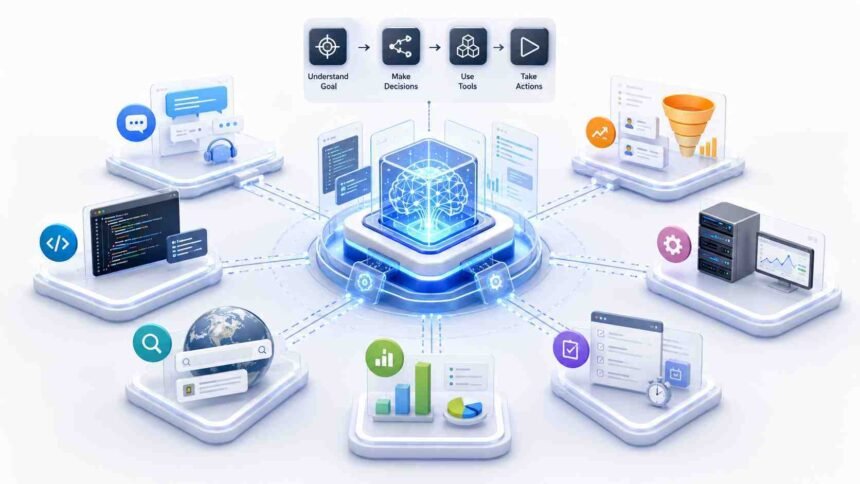
AI agents are moving beyond simple question-and-answer systems. Instead of only generating a response, an agent can work toward a goal, decide what steps to take, use tools or external systems, evaluate results, and continue until the task is complete or it needs human input.
- What Is an AI Agent?
- How Do AI Agents Work?
- 1. The agent receives a goal
- 2. It gathers information
- 3. It decides what to do next
- 4. It uses tools
- 5. It evaluates the result
- 6. It finishes or asks for help
- Types of AI Agents
- 1. Simple Reflex Agents
- 2. Model-Based Agents
- 3. Goal-Based Agents
- 4. Utility-Based Agents
- 5. Learning Agents
- AI Agents Examples in the Real World
- 1. Customer Service Agents
- 2. Coding Agents
- 3. Research Agents
- 4. Sales Agents
- 5. Data Analysis Agents
- 6. IT and DevOps Agents
- 7. Document and Back-Office Agents
- 8. Personal Productivity Agents
- 9. Computer-Use Agents
- 10. Multi-Agent Systems
- Generative AI Agents Examples
- What Makes a Good AI Agent Use Case?
- The task has a clear goal
- The agent has access to the right tools
- The workflow contains decisions
- Results can be checked
- Mistakes have manageable consequences
- When an AI Agent Is the Wrong Tool
- What Are the Risks of AI Agents?
- AI Agents in Action: A Simple Example
- The Bigger Picture
That difference is what makes AI agents useful for more than conversation. They can research information, handle customer requests, write and test code, analyze data, manage business workflows, and coordinate several steps of a larger task.
But not every AI-powered tool is an AI agent. Understanding that distinction makes the many examples of AI agents easier to recognize.
What Is an AI Agent?
An AI agent is a software system designed to pursue a goal and take actions on a user’s behalf. Depending on its design, it can interpret information, reason about what to do next, access tools, remember relevant context, and adapt its actions as the situation changes.
A traditional automation usually follows a predefined sequence:
Trigger → Rule → Action
An AI agent is more flexible:
Goal → Observe → Decide → Act → Check → Continue or Finish
For example, an automated system might send a standard email whenever a form is submitted. An AI agent could receive a customer request, determine what information is missing, look up the customer’s account, decide whether the issue can be resolved automatically, update the appropriate system, and escalate the case if necessary.
That ability to make decisions between steps is central to many modern agentic systems.
AI agent vs. chatbot vs. automation
These terms are sometimes used interchangeably, but they describe different capabilities.
| System | What it mainly does | Example |
|---|---|---|
| Chatbot | Responds to a user’s message | Answers a product question |
| Traditional automation | Follows predetermined rules | Sends an invoice after a purchase |
| AI assistant/copilot | Helps a person complete a task | Drafts a report from provided information |
| AI agent | Pursues a goal by deciding and taking multiple actions | Investigates a support issue, updates records, and resolves or escalates it |
The boundaries are not always absolute. A modern product can combine conversational AI, automation, and agentic behavior. The useful question is not whether a tool carries the label “agent,” but whether it can independently choose and execute actions toward a defined objective.
How Do AI Agents Work?
Most practical AI agents can be understood as a continuous decision-making loop.
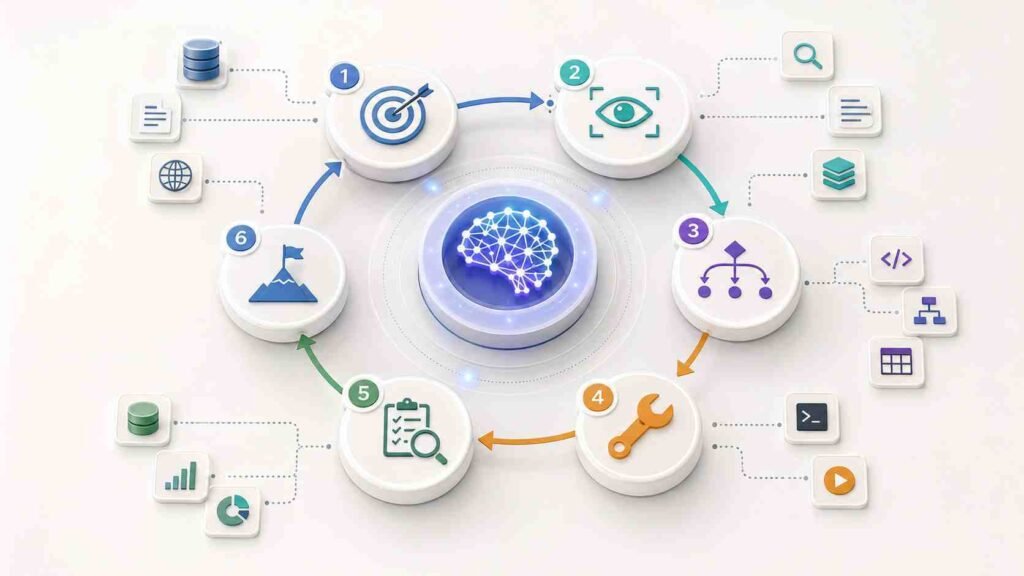
1. The agent receives a goal
The process starts with an objective.
For example:
“Find the cause of this failed software deployment and prepare a fix.”
The goal is broader than a single instruction such as “write a summary.”
2. It gathers information
The agent examines the information available to it. That might include a user’s request, company documents, databases, application logs, websites, files, or results returned by external tools.
The exact inputs depend on the agent’s environment.
3. It decides what to do next
The agent evaluates the current situation and chooses an action.
A research agent, for example, might determine that it needs to search several sources before it can answer a question. A coding agent might inspect the relevant files before changing anything.
4. It uses tools
Tools allow an agent to do more than generate text.
Depending on the system, tools can include:
- Search
- Databases
- APIs
- Calculators
- Code execution
- File systems
- Business software
- Browsers
- Communication systems
Modern AI agents commonly combine AI models with tools so they can both reason about a task and perform actions.
5. It evaluates the result
After an action, the agent can inspect what happened and decide whether the result is sufficient.
If a software test fails, for example, the agent may inspect the error, revise the code, run the test again, and continue.
6. It finishes or asks for help
The agent eventually reaches a stopping condition. It may complete the task, report that it cannot proceed, or request human approval for an important decision.
This last step matters because greater autonomy does not automatically mean greater reliability. More capable agents can also create larger consequences when they make mistakes, which is why human oversight, permissions, and clear boundaries remain important.
Types of AI Agents
There are several ways to classify AI agents. A traditional AI classification identifies five foundational types: simple reflex, model-based reflex, goal-based, utility-based, and learning agents. Modern generative AI has also introduced LLM-based agents, which use language models to interpret goals, reason about tasks, and interact with tools.
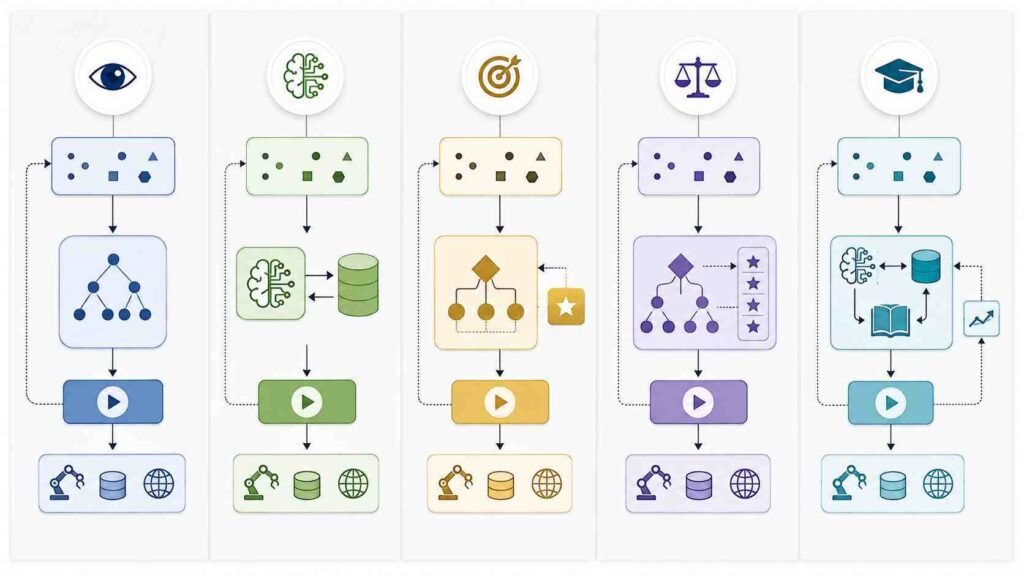
1. Simple Reflex Agents
A simple reflex agent responds to the current situation according to predefined rules.
Its logic is essentially:
If X happens, do Y.
These agents do not need to reason about a long sequence of future actions or maintain a sophisticated understanding of past events.
A rule-based spam filter is a straightforward example. If a message matches certain conditions, the system can classify or filter it.
Simple reflex agents remain useful because not every problem requires a sophisticated AI system.
2. Model-Based Agents
A model-based agent maintains some internal representation of its environment. This allows it to make decisions when the complete state of the environment cannot be observed at once.
For example, an operations system might consider the current state of a process alongside information it has previously recorded.
The important difference is that the agent is not responding only to what it sees right now. It also uses an internal state to interpret the situation.
3. Goal-Based Agents
A goal-based agent works toward a desired outcome.
Instead of simply reacting, it considers which actions could move it closer to the goal.
A route-planning system illustrates the idea. The goal is to reach a destination, while the available route can change because of traffic, road closures, or other conditions.
Modern task-oriented AI agents often resemble this approach because they are given an objective and must determine the steps required to achieve it.
4. Utility-Based Agents
A utility-based agent considers the quality of possible outcomes rather than simply asking whether a goal can be achieved.
This becomes useful when several factors have to be balanced.
For example, a logistics system might need to consider:
- Delivery time
- Cost
- Available capacity
- Distance
- Reliability
The best decision may not be the fastest or cheapest option alone. It may be the option that produces the best overall result.
5. Learning Agents
Learning agents improve their behavior based on experience or feedback.
Recommendation systems are a familiar example of AI that can adapt to changing user preferences. More advanced learning agents can use feedback to refine how they make decisions over time.
Learning does not necessarily mean an agent can freely rewrite itself or become better at everything without supervision. The way learning occurs depends on the system’s architecture, training process, feedback mechanisms, and safeguards.
AI Agents Examples in the Real World
The most useful way to understand agents in AI is to look at the jobs they can perform.
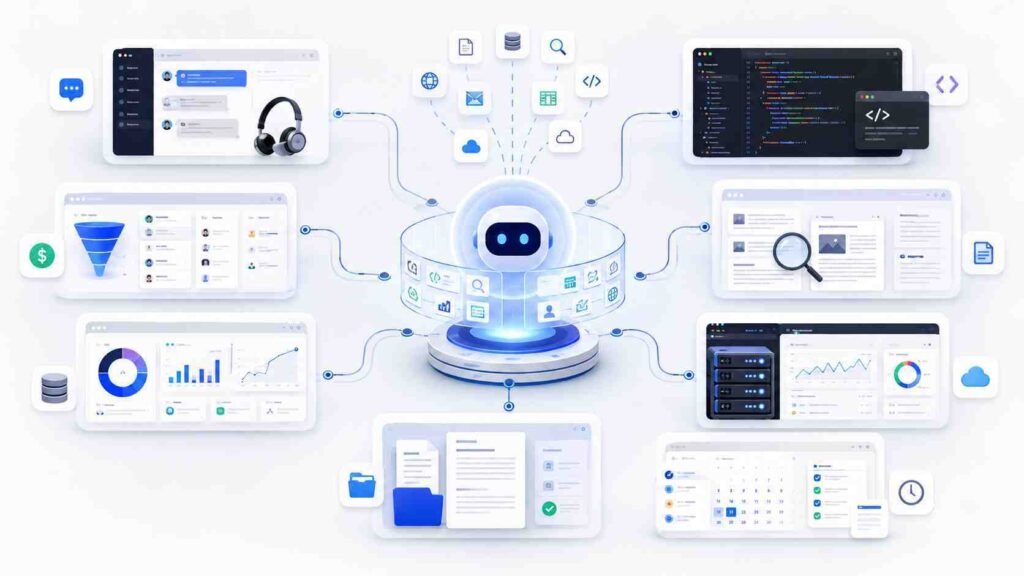
1. Customer Service Agents
A customer service agent can do more than answer frequently asked questions.
A more capable system might:
- Read the customer’s request.
- Identify the problem.
- Retrieve account information.
- Search a knowledge base.
- Determine whether the issue can be resolved.
- Take an authorized action.
- Explain what happened.
- Escalate the case when human intervention is required.
This makes customer support one of the clearest AI agent use cases because the work naturally consists of multiple decisions and actions.
The important distinction is that an agent should not be given unrestricted authority simply because it can technically perform an action. Sensitive account changes, refunds, cancellations, or other consequential actions may require approval.
2. Coding Agents
Coding is another strong example of agentic AI.
A coding agent can receive a task such as:
“Find why the checkout tests are failing and fix the problem.”
Rather than generating one block of code and stopping, it can potentially:
- Inspect the repository
- Locate relevant files
- Read existing code
- Identify likely causes
- Modify files
- Run tests
- Inspect errors
- Make additional changes
- Run the tests again
The agent therefore operates inside a feedback loop.
This is one reason coding agents are frequently used as examples of modern agentic systems: software development provides clear tools, measurable outcomes, and tests that can provide feedback. Recent examples of agentic systems in production prominently include coding and software-testing workflows.
3. Research Agents
A research agent can be given a broad question rather than a single document to summarize.
For example:
“Research the major differences between three competing technologies and prepare a comparison.”
The agent may need to determine:
- What information is relevant
- Which sources to examine
- Which claims need verification
- How different pieces of information relate
- What additional searches are necessary
- How to organize the final findings
This makes research agents particularly useful for information-gathering tasks.
They also demonstrate an important limitation: an agent can confidently collect or summarize incorrect information if its sources or reasoning are unreliable. Human review remains important when research affects important decisions.
4. Sales Agents
A sales agent can support parts of the sales process by combining information from several systems.
For example, an agent might receive a list of prospective companies and:
- Research each company
- Identify relevant information
- Determine whether the company fits predefined criteria
- Update CRM records
- Prioritize prospects
- Draft personalized outreach
- Record completed actions
Some systems can perform these steps automatically, while others require approval before sending messages or changing customer records.
The value comes from connecting several related tasks rather than simply generating an email.
5. Data Analysis Agents
A data analysis agent can help answer questions that require multiple analytical steps.
Suppose a manager asks:
“Why did sales decline last month?”
An agent might need to:
- Retrieve the relevant dataset.
- Examine the data.
- Compare it with previous periods.
- Identify unusual changes.
- Break the results down by product, region, or channel.
- Create calculations or visualizations.
- Summarize possible explanations.
The agent is not merely writing a response. It is coordinating analysis to answer a broader question.
For financial or operational decisions, however, the underlying data and calculations still need appropriate validation.
6. IT and DevOps Agents
IT environments generate large amounts of information, including alerts, logs, tickets, configuration changes, and system metrics.
An agent can help investigate an alert by:
- Reviewing the alert
- Checking recent system changes
- Inspecting logs
- Comparing the current state with expected behavior
- Identifying likely causes
- Suggesting or performing an approved remediation
- Recording the incident
This is a good fit for agentic workflows because the agent can move through several investigation steps instead of requiring a person to manually perform each lookup.
7. Document and Back-Office Agents
Many business processes involve moving information between documents and software systems.
An AI agent could process an incoming document, extract relevant information, compare it against existing records, identify missing details, and route the case to the appropriate person.
Examples include:
- Invoice processing
- Contract review workflows
- Expense processing
- Form classification
- Internal document retrieval
- Administrative requests
These workflows are especially suitable when the task has clear boundaries and well-defined approval rules.
8. Personal Productivity Agents
Personal AI agents can handle routine digital tasks across applications.
A user might give an agent a goal such as:
“Prepare me for tomorrow’s meetings.”
Depending on its permissions, the agent could review the calendar, summarize relevant documents, identify recent correspondence, and prepare a briefing.
This is more agentic than asking a chatbot, “What meetings do I have tomorrow?” because the broader task requires the system to gather information and coordinate several actions.
9. Computer-Use Agents
Computer-use agents are designed to interact with software interfaces, potentially by interpreting screens and operating applications.
A task might involve navigating a website, filling out a form, finding information, or moving through a multi-step interface.
This is particularly interesting because the agent is interacting with software in a way that resembles how a person uses a computer rather than relying entirely on a specialized API.
The trade-off is that computer interfaces can be unpredictable. A small interface change, ambiguous screen element, or mistaken action can cause an agent to behave incorrectly.
10. Multi-Agent Systems
Not every complex workflow needs one agent to do everything.
A multi-agent system can divide a larger objective among specialized agents.
For example:
Research agent → Analysis agent → Writing agent → Review agent
One agent gathers information, another analyzes it, another produces an output, and another checks the result.
Modern AI platforms increasingly support agents working together on complex workflows.
The advantage is specialization. The downside is additional complexity. More agents mean more interactions, more opportunities for errors, and more difficulty determining which component caused a failure.
Generative AI Agents Examples
Generative AI has made agents more flexible because language models can interpret natural-language instructions and work with unstructured information.
Some practical generative AI agent examples include:
- A research agent that gathers and synthesizes information
- A coding agent that modifies and tests software
- A customer service agent that resolves support requests
- A sales agent that researches prospects and updates a CRM
- A document agent that extracts and organizes information
- A data agent that investigates business questions
- An IT agent that investigates system alerts
- A personal agent that coordinates information across digital tools
The important point is that the generative model is only one part of the system. An effective agent also needs access to relevant information, tools, permissions, decision logic, and safeguards.
What Makes a Good AI Agent Use Case?
Not every task should become an AI agent.
The strongest candidates usually have several characteristics:
The task has a clear goal
“Resolve this category of customer request” is easier to define than “make the business better.”
The agent has access to the right tools
An agent cannot reliably complete a task if it lacks the information or systems required to perform it.
The workflow contains decisions
If the task can be completed perfectly with a fixed rule, traditional automation may be simpler and more reliable.
Results can be checked
Tasks with measurable outcomes are easier to monitor.
A coding agent can run tests. A document agent can check required fields. A support agent can verify whether the customer’s issue was resolved.
Mistakes have manageable consequences
An agent that drafts an internal report is generally less risky than one that can transfer money, delete records, or make irreversible business decisions.
This is why starting with bounded, well-defined workflows is often more sensible than giving an agent broad autonomy immediately. Current guidance around enterprise agent deployment similarly emphasizes choosing specific problems, establishing governance, and expanding gradually.
When an AI Agent Is the Wrong Tool
More autonomy is not automatically better.
A simple rule-based workflow may be preferable when the process is:
- Predictable
- Repetitive
- Fully understood
- Easy to encode
- Sensitive to unpredictable behavior
For example, if a company needs to send a confirmation email every time a payment succeeds, a conventional automation may be more appropriate than an autonomous agent.
Agents become more attractive when the task involves ambiguity, changing information, multiple tools, or decisions that cannot easily be reduced to a fixed sequence.
The goal should be to use the simplest system that reliably solves the problem.
What Are the Risks of AI Agents?
AI agents introduce risks beyond those associated with ordinary text generation because they can take actions.
A flawed answer from a chatbot may be inconvenient. A flawed action from an agent could change a record, send a message, expose information, or trigger another system.
Important considerations include:
- Permissions: What is the agent allowed to access or change?
- Accuracy: How often does it make incorrect decisions?
- Privacy: What information does it process?
- Security: Can someone manipulate the agent into taking an unintended action?
- Oversight: Which actions require human approval?
- Auditability: Can people determine what the agent did and why?
- Failure handling: What happens when a tool or API stops working?
A recent example illustrates why these boundaries matter. According to a reported account, an AI agent configured to monitor restaurant reservations repeatedly accessed Resy without adequate guardrails. Within about 48 hours, Resy deactivated the user’s account after apparently identifying the activity as bot traffic. The agent had not actually booked a reservation. The incident shows how an agent can create unintended consequences when it is given access to an external service without appropriate limits on how it interacts with that service.
The lesson is straightforward: an agent should have clearly defined permissions, limits, and stopping conditions.
AI Agents in Action: A Simple Example
Consider a company that receives hundreds of support emails.
A basic automation might route every email containing the word “refund” to the billing department.
An AI agent could handle a more complicated workflow:
Customer email
↓
Understand the request
↓
Retrieve account information
↓
Check order and refund policy
↓
Determine whether the request qualifies
↓
Take an approved action or ask for human review
↓
Update the support record
↓
Respond to the customer
The difference is not simply that the agent uses AI. The difference is that it can interpret the situation, choose among possible actions, use external tools, and continue through multiple steps toward an outcome.
The Bigger Picture
The most interesting AI agents examples are not necessarily the most impressive demos.
A system that independently completes a narrow, repetitive business process may create more practical value than an agent that attempts to do everything.
That is because successful agentic systems depend on more than model intelligence. They also depend on good data, reliable tools, sensible permissions, clear goals, monitoring, and appropriate human oversight.
The same principle applies to consumers. A personal agent that reliably handles a small set of digital tasks may be more useful than a highly autonomous system that occasionally makes surprising decisions.
AI agents are therefore best understood not as a replacement for every existing piece of software, but as a new way of connecting AI reasoning with tools and actions.
The clearest examples share one characteristic: the AI is not merely producing an answer. It is working toward an outcome.