


IT and cybersecurity are closely connected, but they are not the same field.
- What Is IT?
- What Is Cybersecurity?
- IT vs Cybersecurity: The Key Difference
- Is IT Security the Same as Cybersecurity?
- Information Security vs Cybersecurity
- How IT and Cybersecurity Work Together
- What Does an IT Professional Do?
- What Does a Cybersecurity Professional Do?
- IT Security vs Cybersecurity in Practice
- Is Cybersecurity Part of IT?
- Cybersecurity and IT Security: Why the Terms Get Confused
- Which Is Better: IT or Cybersecurity?
- The Bottom Line
Information technology (IT) covers the systems and technology organizations use to operate, communicate, store information, and deliver services. Cybersecurity is more specialized, focusing on protecting digital systems, networks, devices, and data from cyber threats.
That distinction can become confusing because terms such as IT security, cybersecurity, and information security are often used interchangeably. They overlap significantly, but their scope is not always identical.
Here is a practical look at how IT and cybersecurity differ, where they overlap, and how IT security and information security fit into the picture.
What Is IT?
Information technology is the broader field concerned with using and managing technology to support an organization.
An IT team may be responsible for setting up computers, managing networks, maintaining servers, supporting employees, managing software, administering cloud services, and troubleshooting technical problems.
Typical IT responsibilities can include:
- Setting up and maintaining computers and other devices
- Managing networks and internet connectivity
- Installing and updating software
- Administering servers and cloud systems
- Managing user accounts and access
- Backing up and recovering data
- Troubleshooting hardware and software problems
- Supporting employees with technical issues
- Maintaining an organization’s technology infrastructure
The primary objective of IT is not necessarily security. IT is about making technology available, functional, reliable, and useful to the organization.
Security is an important part of that responsibility, but it is only one part of IT.
What Is Cybersecurity?
Cybersecurity is the practice of protecting digital systems, networks, devices, applications, and data from cyber threats.
Those threats can include malware, ransomware, phishing, unauthorized access, data theft, and other forms of malicious activity.
Cybersecurity professionals may work on tasks such as:
- Monitoring systems for suspicious activity
- Identifying security vulnerabilities
- Investigating security incidents
- Protecting networks and endpoints
- Testing systems for weaknesses
- Managing security controls
- Responding to cyberattacks
- Developing security policies and procedures
- Protecting identities and access
- Helping organizations reduce cyber risk
The focus is therefore different from general IT.
An IT professional might be responsible for making sure employees can access a company’s systems. A cybersecurity professional may be concerned with whether those same systems can be accessed by someone who should not have access.
IT vs Cybersecurity: The Key Difference
The simplest way to understand the difference is to look at the purpose and scope of each field.
| IT | Cybersecurity |
|---|---|
| Manages and supports technology | Protects technology and digital assets from threats |
| Focuses on availability, functionality, and reliability | Focuses heavily on security and risk |
| Covers hardware, software, networks, systems, and support | Focuses on defending digital systems, networks, applications, devices, and data |
| Troubleshoots technical problems | Investigates and responds to security problems |
| May implement security controls | Designs, monitors, tests, and improves security controls |
| Supports the organization’s overall technology environment | Specializes in reducing cyber risk |
There is considerable overlap. In a smaller organization, the same person may handle both IT and cybersecurity responsibilities.
In a larger organization, however, IT and cybersecurity are often separate functions that work closely together.
Is IT Security the Same as Cybersecurity?
Not necessarily.
The terms are closely related, and organizations sometimes use them interchangeably. But they can describe slightly different scopes.
IT security generally refers to protecting an organization’s information technology assets, including computers, networks, devices, applications, and related infrastructure.
Cybersecurity focuses specifically on protecting digital systems and information against cyber threats.
This means cybersecurity can be viewed as a specialized part of the broader security responsibilities surrounding IT.
However, terminology varies between organizations. A company may call its security team an IT security team even when most of its work is cybersecurity.
So if you see a job advertised as “IT security” or “cybersecurity,” the title alone does not tell you exactly what the person will do. The responsibilities in the job description matter more.
Information Security vs Cybersecurity
Information security, often shortened to InfoSec, is another related term that can cause confusion.
The key difference is what is being protected.
Information security is concerned with protecting information, regardless of the form that information takes. That can include digital files, databases, physical documents, and other forms of recorded or communicated information.
Cybersecurity has a more specific digital focus. It is primarily concerned with protecting digital systems and information from cyber threats.
For example, imagine a company has confidential customer information.
Protecting that information from a hacker who breaks into the company’s network is a cybersecurity concern.
Protecting the same information from unauthorized access to a physical filing cabinet is an information security concern, but it is not necessarily a cybersecurity problem.
This is why information security can have a broader scope than cybersecurity.
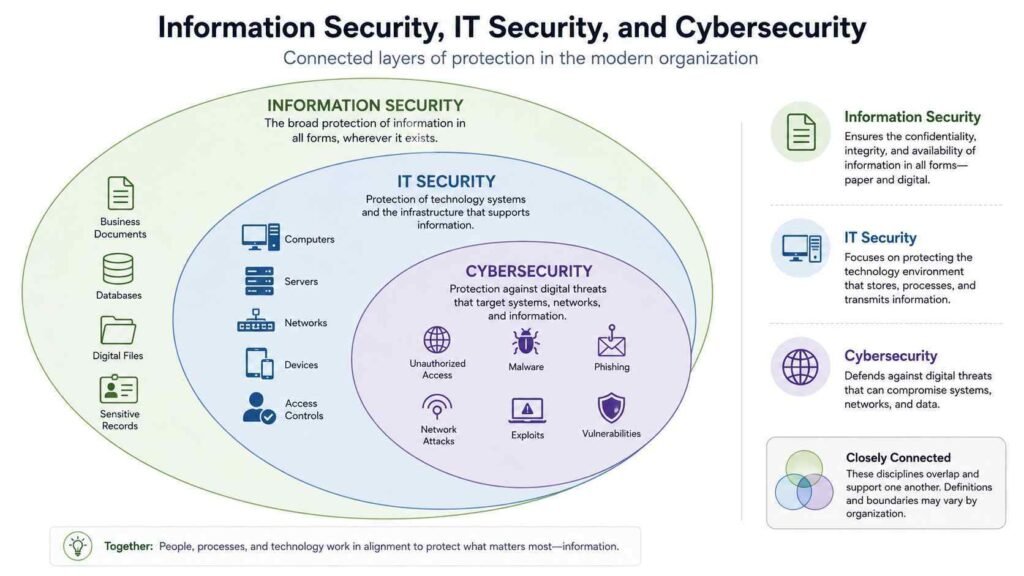
A simple way to remember the distinction
Think of the three terms this way:
Information security: Protect the information.
IT security: Protect the organization’s technology environment.
Cybersecurity: Protect digital systems and information from cyber threats.
These areas overlap heavily, so the boundaries are not always perfectly defined in everyday business language.
How IT and Cybersecurity Work Together
IT and cybersecurity are not competing disciplines. They depend on each other.
Consider a company’s employee laptop.
The IT team may:
- Configure the laptop
- Install required software
- Connect it to company systems
- Create or manage the employee’s account
- Troubleshoot technical problems
- Maintain the device
The cybersecurity team may:
- Require multifactor authentication
- Monitor the device for suspicious activity
- Deploy endpoint security controls
- Investigate malware alerts
- Check for security vulnerabilities
- Respond if the device is compromised
Both teams are working with the same technology, but their priorities are different.
This relationship becomes even more important as organizations rely on cloud services, remote work, mobile devices, interconnected applications, and other digital systems.
What Does an IT Professional Do?
IT roles can vary considerably depending on the organization.
Common IT positions include:
- IT support specialist
- Help desk technician
- Systems administrator
- Network administrator
- Cloud administrator
- IT manager
- Database administrator
- Systems engineer
An IT professional might spend much of the day solving technical problems, maintaining infrastructure, configuring systems, or helping employees use technology effectively.
Security knowledge is increasingly useful in these roles because poorly configured or outdated technology can create security risks.
But an IT professional does not necessarily specialize in cybersecurity.
What Does a Cybersecurity Professional Do?
Cybersecurity roles also vary, but their work is centered more directly on protecting systems and information from security threats.
Examples include:
- Security analyst
- Security engineer
- Penetration tester
- Incident responder
- Security operations center (SOC) analyst
- Threat analyst
- Security architect
- Security manager
A cybersecurity professional may investigate suspicious activity, assess vulnerabilities, monitor security alerts, test defenses, or help respond to an attack.
Some roles are defensive, while others involve authorized security testing designed to find weaknesses before malicious attackers can exploit them.
IT Security vs Cybersecurity in Practice
The distinction becomes easier to see with a practical example.
Suppose a business discovers that an employee’s computer is running slowly.
An IT professional might investigate the operating system, installed applications, hardware, network connection, or other technical causes.
Now suppose the same computer begins connecting to an unfamiliar server and security software detects suspicious activity.
The cybersecurity team may investigate whether malware or another security threat is responsible, determine what systems may have been affected, and take steps to contain the incident.
The two teams may work together, but they are approaching different aspects of the problem.
This is one reason organizations benefit from having both strong IT operations and strong security practices.
Is Cybersecurity Part of IT?
In many organizations, cybersecurity is closely connected to IT and may be considered a specialized area within the broader technology function.
But cybersecurity has developed into its own professional discipline, with specialized roles, tools, frameworks, techniques, and responsibilities.
Someone can therefore work in IT without being a cybersecurity specialist.
Likewise, someone working in cybersecurity may have a strong IT background but spend most of their time on security rather than general technical support.
The relationship is similar to the relationship between a broad field and a specialization: cybersecurity relies on many IT concepts, but its goals and responsibilities are more specifically centered on security.
Cybersecurity and IT Security: Why the Terms Get Confused
The terminology is confusing partly because there is no single naming convention used by every organization.
One company may have an “IT Security” department. Another may call a very similar function “Cybersecurity.” A third may place both under an information security department.
The actual responsibilities can overlap substantially.
For someone comparing careers, courses, or job descriptions, it is therefore better to look beyond the title.
A position called “IT Security Analyst” could involve security monitoring, vulnerability management, access controls, and incident response.
A “Cybersecurity Analyst” could perform many of the same tasks.
The job description is usually more informative than the label.
Which Is Better: IT or Cybersecurity?
Neither field is inherently better. They lead to different types of work.
IT may be a better fit if you enjoy:
- Solving technical problems
- Working with computers and networks
- Managing systems
- Helping users
- Setting up and maintaining technology
- Understanding how technology works across an organization
Cybersecurity may be a better fit if you enjoy:
- Investigating problems
- Finding vulnerabilities
- Thinking about how systems could be attacked
- Monitoring for suspicious activity
- Responding to security incidents
- Learning about threats and defensive techniques
- Protecting systems and information
There is also no requirement to treat them as completely separate career paths. Many cybersecurity professionals begin with IT experience because understanding networks, operating systems, cloud environments, and applications provides a useful technical foundation for security work.
The Bottom Line
IT and cybersecurity overlap, but they answer different questions.
IT asks: How do we build, manage, maintain, and support the technology an organization depends on?
Cybersecurity asks: How do we protect that technology and its digital information from threats and unauthorized activity?
IT security sits close to both areas, while information security takes an even broader view of protecting information in different forms.
The boundaries can vary from one organization to another, so the terminology should not be treated as perfectly standardized. What matters most is understanding the underlying responsibility: IT keeps technology working, while cybersecurity specializes in keeping digital technology and information secure.
That distinction makes it easier to understand the roles, skills, and responsibilities associated with each field.